Developments in the Technical-Scientific Work of Professor Tullio de Rubeis, Building Physics Lecturer
Exactly one year ago, at the Building Physics Laboratory in Monteluco di Roio (L’Aquila), during the study day “A Look to the Future: Designing with Light”, the University of L’Aquila officially inaugurated its Daylighting Laboratory.
Since then, the laboratory has established itself as a reference point for research, education, and experimentation in natural lighting and visual comfort.
Objectives and Activities
The laboratory focuses on studying and promoting the conscious and sustainable use of natural light in buildings, integrating design, energy, and perceptual approaches.
Its activities include:
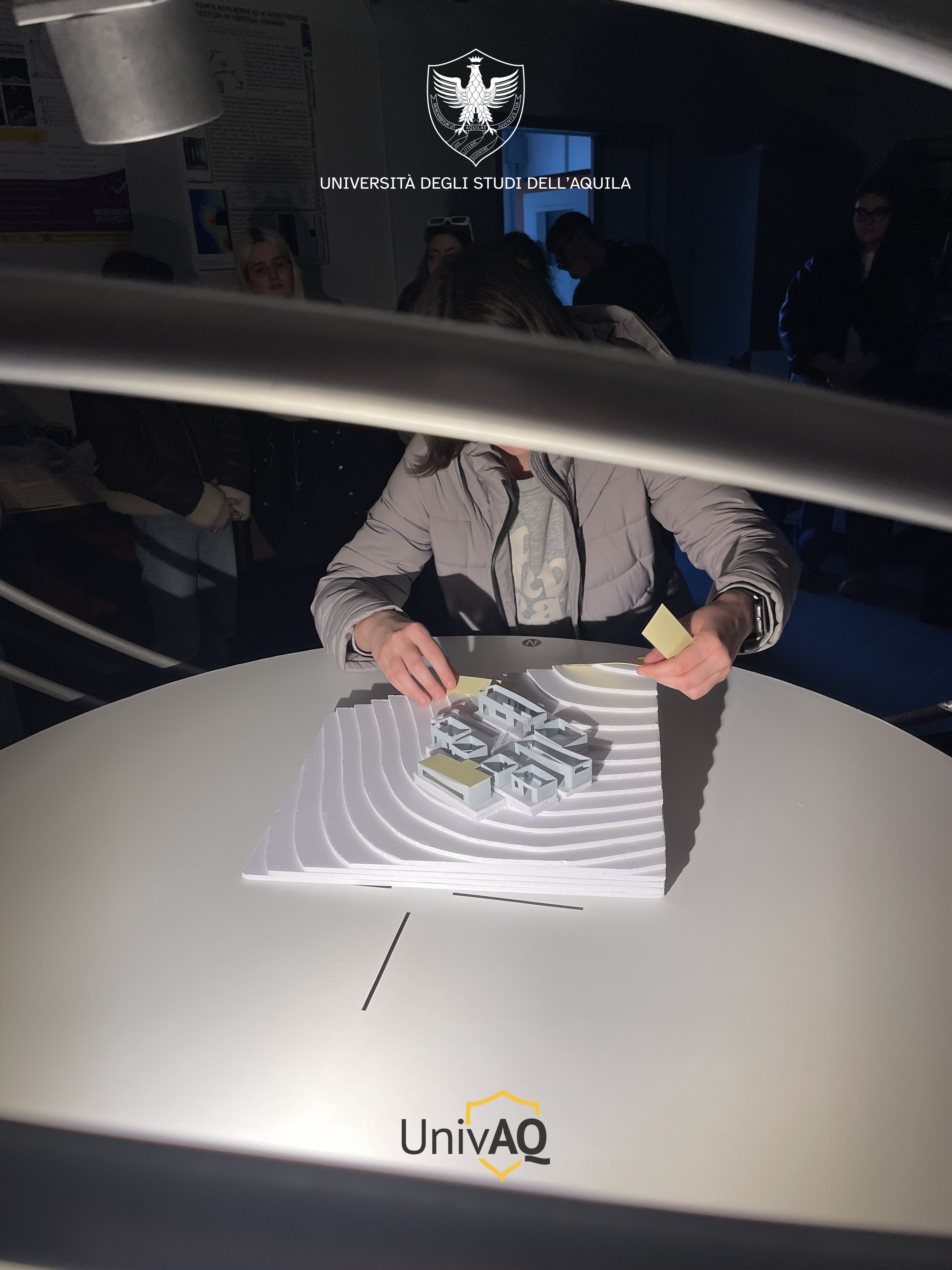
- Experimental analyses on prototypes and scale models to assess the distribution of natural light;
- Numerical simulations to investigate the relationship between lighting, energy consumption, and indoor comfort;
- Support for theses, courses, and workshops dedicated to lighting design, aimed at both students and professionals.
These research efforts aim to develop design solutions that improve the quality of built environments, while reducing energy consumption and enhancing the relationship between light, architecture, and human well-being.
Collaborations and Future Perspectives
The laboratory operates in synergy with the building sector and with national and international research institutions.
Its activities include technology transfer projects, applied studies on existing buildings, and experiments on shading systems and dynamic light control strategies.
Future goals include:
- Expanding measuring instrumentation;
- Establishing interdisciplinary collaborations;
- Promoting advanced training initiatives for designers and researchers.
Role in the Territory and in Education
The laboratory represents a meeting point between teaching, scientific research, and practical application.
For the city of L’Aquila and the Abruzzo region, it serves as a technical competence center supporting building renovation activities and promoting higher quality standards for the built environment.
Examples of Ongoing or Completed Research
- Orchard: study of adaptive shading systems and analysis of glazed surfaces with different types of glass.
- Lobelia: study of the Daylight Factor for different façade configurations and reflection coefficients.
University of L’Aquila
A public university located in L’Aquila, Italy, renowned for its excellence in research and education across scientific, technological, and humanistic fields.
The University promotes innovation and sustainability through interdisciplinary research projects and collaborations with public and private organizations.
Prof. Tullio de Rubeis
Lecturer and researcher in Building Physics at the University of L’Aquila.
He specializes in lighting design, environmental comfort, and energy efficiency in buildings, coordinating research, training, and technology transfer activities in these areas.