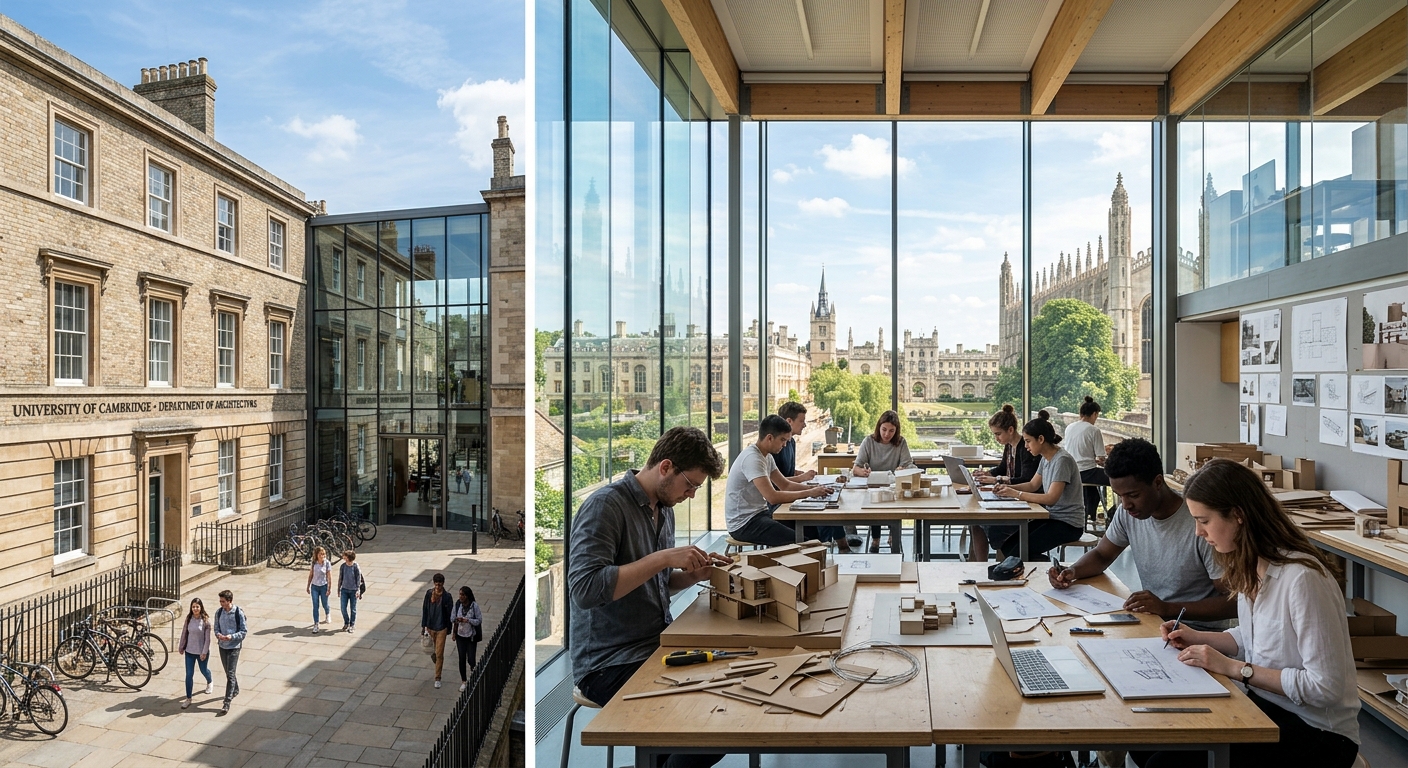
From research at Cambridge to contemporary simulators, a dialogue on the value of physical experimentation in architectural design.
In 2015, David Croghan contacted Giulio Maria Podestà, founder of Nitter–Betanit and designer of its products, to request information and photographs of our simulators for his paper Daylighting by Design. We remember that exchange for the enthusiasm and curiosity he brought to our work, sharing his experience of developing an artificial sky with colleagues at the University of Cambridge.
For us, this was more than a request for illustrations. It was an opportunity to exchange ideas with someone who had devoted a significant part of his career to studying daylight and investigating its behaviour through physical models.
An architect educated at Cambridge, where he completed his PhD in 1963, Croghan held teaching appointments and served as director of the Daylight Research Group during the period from 1962 to 1970. His experience brought together research, education and design consultancy, connecting the study of light with the practical demands of architecture.
The artificial sky he designed was completed at Cambridge in 1962. Known as the “Dome,” it became a tool for research and teaching, also supporting daylighting studies for buildings such as the Hayward Gallery and Pimlico School.
It is this relationship between the laboratory and built architecture that interests us: studying light not as a separate technical issue, but as a way to investigate forms, openings and spaces while design decisions can still be changed.
In Daylighting by Design, Croghan traces the development of artificial skies and discusses examples of testing with scale models. The paper features our Kiwi simulator and an LED artificial sky built by Nitter–Betanit in 2014. He gives particular attention to the latter, identifying the use of LEDs in modular elements as a significant innovation and a potential direction for developing larger, more flexible simulators.
Croghan’s interest in our work encouraged a wider exchange that included distinguished figures such as Sir Colin Humphreys, with whom he discussed the possibilities of developing more sophisticated LED artificial skies. For us, this was a meaningful sign of respect: Croghan saw Nitter–Betanit as a knowledgeable contributor to discussions about the challenges of daylight simulation and its future development. His enthusiasm made the exchange more than an opportunity for visibility; it became a dialogue between different experiences and areas of expertise.
In that dialogue, we recognised common ground: a physical model is not simply a representation to look at, but a tool for thinking. Moving an opening, adjusting a shading element and comparing the behaviour of light turns a hypothesis into an experiment that can be discussed and refined.
Today, combining artificial skies with simulation software opens up new possibilities for research and design. Computational methods allow numerous scenarios to be explored; physical models enable light to be observed and measured on actual surfaces and materials. Comparing the results of both approaches helps challenge assumptions and develop a clearer understanding of the consequences of design decisions.
This is also the message we want to share with students and designers: integrating different tools broadens the scope of investigation while preserving the freedom to experiment. A test does not simply confirm a decision; it can suggest a solution we had not yet imagined.
We warmly remember David Croghan’s interest in our work and dedicate this article to his contribution to daylighting research and design.
Artificial skies and digital simulation are not competing alternatives: together, they offer more opportunities to experiment with, understand and design with daylight.
David Croghan — An architect and researcher educated at the University of Cambridge, where he conducted daylighting research and taught. He is the author of Daylighting by Design (2015) and Daylighting Buildings — Technical Papers 1964–1970, a collection of nine papers on the Cambridge artificial sky and its use in daylighting studies.
Sir Colin Humphreys — A materials scientist who founded the University of Cambridge’s gallium nitride research group. His research has contributed to the development of LED technologies and their applications in lighting.
Department of Architecture, University of Cambridge — Based at Scroope Terrace since 1924, the department combines architectural design, research and hands-on experimentation. The site once housed Croghan’s artificial sky and has since evolved to include a purpose-built design studio designed by Mole Architects. Today, students have access to dedicated studios, model-making workshops and digital fabrication facilities, bringing physical models and computational tools together in architectural education.